Ecclesiastes 3:11
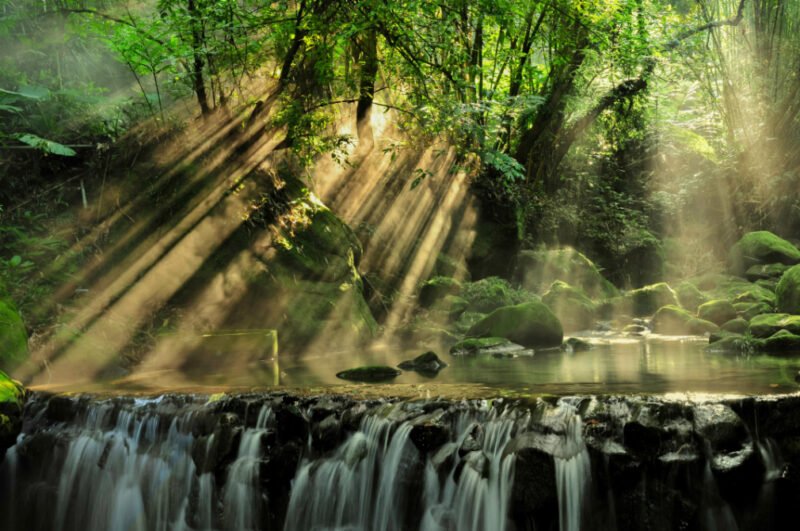
“He has made everything beautiful in its time. Also He has put eternity in their hearts, except that no one can find out the work that God does from beginning to end.”
Question: This verse makes three statements about God and His creation. How have you encountered any or all of these qualities of God in your own life?
1a. He has made everything:
God is the almighty creator of everything, not just the oceans and continents and all life in the sea and air and on land. But He created the very matter out of which all of those were made, in the entire universe, and the space in which the universe exists. And He created time into which space and matter are placed. He also created both visible light and invisible electromagnetic energy, and other forces of interaction between space, matter and time, such as gravity. This is amazing, not easy to fathom, the verses on creation were written before humanity was able to understand what they meant.
1b. Beautiful in its time:
The definition of beauty is elusive; its nature is so difficult to prescribe that the modern art establishment has largely given up and lost any understanding of what is beautiful.
But although it may be elusive, it is seen and highly prized by ordinary humanity, and beautiful objects can command fortunes for their sale value.
I think we see something as beautiful when it is distinct from the chaos and decay we have around us. So much on this earth is either passing away or unravelling in form or behaviour, which is what we see as ugly. But when aspects of this world point to what is beyond the here and now, above the chaos of accidental outcome, aspects that reflect lasting order and unchanging purpose; we see that as beautiful.
One example is that of motherhood in all forms of life, and for humanity, young women represent the source of life and growth of the human population. Motherhood includes giving birth, caring, and nurturing, a fundamental role that is essential to the existence of humanity, which has a timeless quality.
And while we may be familiar with the patterns of cloud forms in the sky, and the huge variety of shapes they take, when combined with perfectly straight radiant rays of orange light in a sunset, they are given a sense of order, they point to what is unchanging and everlasting, something we can rely upon.
2. Put eternity in their hearts
This phrase amplifies Gen 1:27, “God created man in His own image, …, male and female He created them.” The male and female human are different in appearance, but here “image” does not refer to outward appearance, but to the inner nature of God, to His perspective and viewpoint, and to His goodness and righteousness. When humanity lost that aspect of God’s nature in the Fall, it left us with a hunger and thirst for God’s righteousness that nothing we do can satisfy, it’s a longing for the infinite and perfect nature of God that we lost when death entered the world through our sin.
3. No one can find out the work that God does from beginning to end
This points to the severe limits to human understanding, and the humility we need to have in regard to human knowledge compared to the infinite and almighty ways of God.
It reminds me of the quote attributed to Albert Einstein – “The more I learn, the more I realize how much I don’t know” (but we don’t even know if he really said it).
But what is knowledge?
Pilate asked, “What is truth?”, and our modern culture has redefined it in relativistic terms based on internal feelings instead of external reality.
We think of “truth” in terms of patterns that can be stated in words or concepts we can describe, which show a regular order and an unchanging pattern in the world around us. So, it is similar to beauty, in the format of words or language, while beauty has a visual format.
Truth can be tested, it is repeatable, so it is subject to verification by scientific enquiry. As a side note on how our knowledge has been degraded, I recently read an article which reported studies had shown that much (70%) of what is now presented as “science” in journals cannot be verified by scientific study, either because the results do not repeat, or the nature of the theory is not testable.
So, both beauty and truth point to being able to place our trust in something: truth deals with predictable statements about creation, while beauty deals more with our aspirations, hopes, and sense of purpose. Both of these point to their source, our almighty creator God himself; in Him only can we place our trust. All that is true or beautiful comes from God. Their reality is beyond our ability to articulate in full, but they bring God’s meaning, purpose, and love to an otherwise chaotic and hostile world.
Praise God for these gifts!
0 Comments