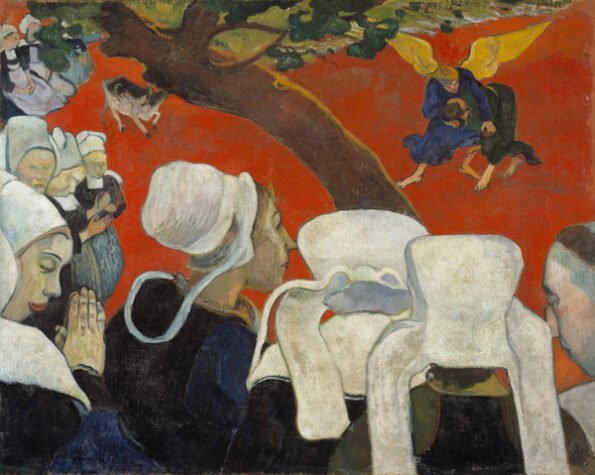
“Epaphras, who is one of you and a servant of Christ Jesus, sends greetings. He is always wrestling in prayer for you, that you may stand firm in all the will of God, mature and fully assured.”
Thie phrase “wrestling in prayer” led me to think of four aspects:
Wrestling with God
(1) Genesis 32:28 — God blessed Jacob because he had wrestled or struggled with him all night long.
28 Then the man said, “Your name will no longer be Jacob, but Israel, because you have struggled with God and with man and have overcome.”
The word Israel means “God strives”, so the people of Israel are noted not for their obedience, but for their struggle or wrestling with God.
The image is the painting by Paul Gauguin, “Vision of the Sermon – Jacob Wrestling with the Angel” — the main focus is not on Jacob and the angel, but on the people who are reflecting on the sermon about this wrestling.
Challenging God
(2) Lamentations, last four verses, 5:19-22 – consists of two sets of two verses; in each set the first verse shows trust in God, but the second confronts and challenges God.
1st – 19 You, O Lord, reign forever;
Your throne endures from generation to generation.
2nd – 20 Why do you always forget us?
Why do you forsake us so long?
3rd – 21 Restore us to yourself, O Lord, that we may return;
Renew our days as of old
4th – 22 Unless you have utterly rejected us
And are angry with us beyond measure.
It’s a fully honest to God prayer from the heart of Jeremiah after the destruction of Jerusalem and exile to Babylon, he’s pouring out to God all his pain and suffering and his doubts and fears, including his doubts about God himself.
It’s a model for personal prayer; it shows what God wants us to do with our hard questions that church doctrine has no answer for. Even when God seems silent or absent in our times of spiritual drought, no one else has the answers, so we need to turn to Him and pour out all that is in our heart.
If we hide our doubts instead, and cover them with statements of church jargon, we are telling God it is all beyond his power, and then those doubts will just remain and grow.
God doesn’t want pretend worship, or pretend prayer, we need to be completely honest to Him. Tackling God with our deepest doubts and questions shows we trust him to deal with them and lift them from us.
Why?
(3) It reminds me of a key insight given to me by a pastor in my early days of questioning, when he explained the differences in approach of Jewish and Greek culture.
The Greeks or Gentiles ask “How?”, which puts their focus on material things, and our society has inherited that in its worship of technology.
The Jews ask the deeper question of “Why?”, and that leads them to God, as only he has the answers.
May we all be blessed with a deep hunger to know why, to lead us to challenge God for answers.
Promise of blessing
(4) The verse points to a promise of God’s blessing when we confront him with those hard questions, that He will give us maturity and assurance to stand firm in his will.
Praise God!
0 Comments